

 Poncho wants to “own the bed.”
 The weather app aims to start engaging with its core user base of millennials the moment they wake up. Around 90% of people 18-30 use smartphones as alarm clocks, according to Cisco, making the lock screen the first thing they see when they crack an eye.
But there’s a lot of competition for eyeballs, even if they’re still crusty with sleep.
“When you pick up your phone in the morning, you probably have a whole bunch of notifications – Instagram, news, texts from friends,” said Ashley D’Arcy, head of creative at Poncho, which launched in 2013 through Betaworks, the startup studio responsible for kickstarting companies like Giphy, Chartbeat and Bitly.
“Our notifications need to be compelling and friendly enough so that we stand out and someone actually wants to open them,” she said.
Poncho combines humor and snackable pop culture-inspired content to encourage engagement. [“Are you Jeff Goldblum after going through a metamorphosis machine, cuz you are lookin’ Fly.”]
The notifications – which founder Kuan Huang refers to as “thin content” – are personalized based on location, morning commute, pet ownership and other data collected during the onboarding process.

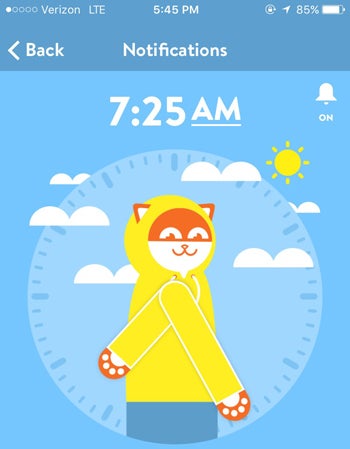
A built-in alarm clock wakes users with tailored weather forecasts within rich, expandable push notifications delivered by the app’s namesake, a hip Brooklyn-dwelling cartoon cat wearing a yellow hooded rainslicker. Poncho also serves up daily horoscopes, motivational quotes and words of the day with GIFs, memes and punchy one-liners.
It’s utility mixed with personality.
“The content is tailored for a new platform – short, light, emotional and push notification-driven,” D’Arcy said. “We’re building a relationship with our users. Poncho is their friend.”
Poncho is also a chatbot and recently expanded to the Facebook Messenger, Kik and Viber chat platforms. But the Poncho team found that users have been asking its titular weather-cat about more than just the weather – they may bring up their job, who they’re dating or politics.
Although Poncho isn’t yet equipped to handle the back and forth those types of non-weather-related conversations require, it’s investing more in artificial intelligence and creating flows to accommodate other subjects.
 After D’Arcy and Huang appeared on Apple’s app incubator show “Planet of the Apps” in July, Poncho raised $2.4 million in seed funding led by Lightspeed Ventures. Poncho will spend the bulk of the money on AI, engineering, natural language processing (NLP) and scaling its user base.
Rather than automating content, Poncho uses artificial intelligence to better understand what users are asking about so that its editors can craft better content.
“We use an NLP library to process human language,” Huang said. “Based on the responses, we gather insights that we use to influence different conversation flows. But if Poncho doesn’t understand something, he acknowledges that he’s a bot. It’s better to acknowledge that you don’t know rather than to pretend.”
Poncho the cat can get away with a lot “because, well, he’s a cat,” D’Arcy joked.
The Poncho Messenger bot and the app have seven-day retention rates of about 50%, meaning half of users stick around after seven days. The average retention rate after one week is 13% for Android apps and 11% for iOS apps, according to Appboy.
The question, of course, is how to monetize that engagement.
Poncho once considered dabbling in commerce – selling toothbrushes and other items people use daily – but combining content and commerce is tricky. If the commerce doesn’t feel contextual, the content’s authenticity is questioned.
“We see ourselves more as a media company,” said Huang, noting that Lightspeed has encouraged Poncho to focus on growth first and monetization after.
When that time comes, Poncho will focus on publisher partnerships and sponsored content with brands such as GE. The app is finalizing a syndication deal with a large publisher so that its content can appear on other properties.
Rather than actually selling stuff itself, Poncho can “act as a virtual influencer to impact purchase decisions,” Huang said.
“Communication is a basic need of human beings, and we’re trying to enhance that experience where people spend most of their time, which is on their phones and in messaging apps,” he said. “We’re combining weather, entertainment and communication together, and we think that is the future of content.”
This is the 14th installment of Home Screen, a series of profiles on mobile pubs and apps and the devs that make them (and hopefully make money on them). Read about home décor app Lux, teen voting app Wishbone, wedding planner platform The Knot, lip-syncing app Musical.ly, pop culture magazine Movie Pilot, news app News Republic, on-demand laundry app Cleanly, music streaming app LaMusica, P2P global shopping app Grabr, kid-friendly chat app Jet.me, driving app Dash, anonymous app Whisper, storytelling app Episode, online writing community Wattpad and sticker app Emogi.







