

 Verizon completed its $4.5 billion acquisition of Yahoo’s search, email and digital media assets on Tuesday, almost a year after announcing its intent to buy the first-wave internet giant.
Marissa Mayer, Yahoo’s embattled CEO since 2012, is leaving the company.
Just because Verizon has cleared the first and most fundamental hurdle in creating Oath, the combined AOL-Yahoo media group, doesn’t mean the telco is finished with its ad tech obstacle course.
Below are selections of AdExchanger’s Yahoo coverage over the last year that answer key questions about what’s to come.
After Verizon agreed to buy Yahoo last year, industry executives predicted a wave of layoffs would follow the merger. That speculation is meeting reality, as Oath has confirmed plans to fire more than 2,000 of its 14,000 employees.

Yahoo’s mobile ad marketplace, Flurry, acquired for more than $300 million in 2014, is a direct competitor of AOL’s Millennial Media, which it bought in 2015 for $300 million. And the most duplicative products come in the form of video advertising assets: Adap.tv and Vidible bundled into an offering called One by AOL and Yahoo’s BrightRoll exchange.
“I’m sure there’s a lot of potential overlap and a technical nightmare to [overcome],” said Gartner research VP Marty Kihn last year. “BrightRoll might be history.”
Flurry, on the other hand, was one of the pieces Verizon coveted in the deal and is likely to be one of the first pieces integrated into the Oath stack, sources told AdExchanger last year.
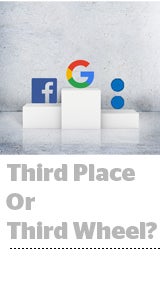
The big question for Verizon’s Oath will be: Can this be a viable walled-garden competitor to Google and Facebook, the reigning powers in cross-device advertising?
How Will Verizon Combine The Data?
Late last year, Verizon informed subscribers that it would be combining data like home addresses, email addresses and mobile device IDs with AOL cookies, emails and online user advertising IDs.
“Verizon is making aggressive moves to become a meaningful No. 3 to Facebook and Google,” said Jennifer Lum, co-founder and former CSO of the cross-device advertising platform Adelphic, prior to its acquisition by Time Inc.’s Viant earlier this year.
Can Oath Become Facebook/Google Competitor?
But Verizon is still a long way from stepping onto the podium alongside Google and Facebook. For instance, though both AOL and Yahoo have large email account user bases, those accounts remain almost entirely desktop – meaning Verizon loses the mobile foothold Google has via its billion-plus Gmail app downloads.
Without those mobile connections, Verizon “would not have device IDs and would need to use probabilistic models to match them,” according to Mike Caprio, now Sizmek’s chief growth officer.
Verizon can use its own data and commingled AOL-Yahoo data to probabilistically extend its cross-device reach even when it doesn’t have mobile email logins (it does know devices and mobile subscriber data, after all), but will have to tread lightly on the issue.
“Verizon would clearly love to commingle its customers’ browsing data with AOL’s and, ultimately, Yahoo’s to create a tracking footprint on par with Facebook and Google,” said Digital Content Next CEO Jason Kint.
Even with the FCC and FTC loosening restrictions on internet service providers this year, Verizon has suffered consumer blowback and fines due to previous FCC investigations into its opt-in and tracking policies.
Verizon maintaining linkages between Oath users and its mobile subscribers will be “critical in light of the digital oligopoly/walled gardens of Facebook and Google controlling 80% of ad budgets,” Elgin Thompson, managing director of Digital Capital Advisors, told AdExchanger this year. “Verizon/AOL/Yahoo would still be probabilistic, but would move closer to deterministic.”
One thing Verizon will have going for it is industrywide support for some business, any business, to undercut Google’s and Facebook’s digital ad dominance founded on deterministic targeting.
Even the massive Verizon-Oath data will be dwarfed by the duopoly, Caprio said. “But sometimes being the ‘open’ alternative is enough to move the needle.”








