 It’s a frenzied IPO season in the ad tech space. Despite the tepid reaction of investors to public offerings by Tremor and YuMe, companies like Rocket Fuel aren’t showing signs of cold feet.
True, it helps to have a set of impressive financials, which Rocket Fuel submitted to the SEC last week. The Redwood City, CA-based demand side platform/ad network is looking to raise $100 million by going public, according to Rocket Fuel’s S-1 filing. On the plus side, it was able to double its client list to 784 and grow its revenue by 139% to $106 million last year. But net losses have widened as well. Rocket Fuel ended last year with a net loss of $10.3 million and ended the first six months of 2013 with a loss of $11.9 million.
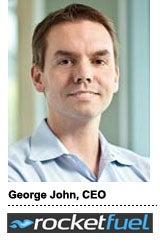
Investors are likely to shrug off the net losses in the face of continued revenue gains like the one Rocket Fuel got last year, particularly as its gross margins inched up to 46% between January and June 2013 – 2 percentage points higher than the same period in 2012. But the real question facing Rocket Fuel CEO George John is whether the display market will continue its double digit gains over the last few years, or if the online ad industry is looking at slower growth – and even greater competition – for the display pie.

Growth Rates Ebb
Rocket Fuel is squarely in the display space, as opposed to the faster growing video segment, where YuMe and Tremor are focused. Despite the perennial hopes of migrating TV dollars, most companies and analysts note that video is mostly benefiting from a shift from banners to streaming visuals.
And while online advertising is still healthy, growth is inevitably slowing down. Most recently GroupM, which just downgraded its total advertising forecast for this year and next, noted online advertising will gain 18% this year and 19% in 2013. Certainly, those are strong growth rates, but the law of large numbers say that the strength is ebbing sooner than later.
Comparable Display Ad Companies
The best antecedents of Rocket Fuel’s move into the public markets may be AOL, with its performance-based third party network, and interclick, which was a public company before being acquired by Yahoo for $270 million in Nov. 2011.
After several quarters of double-digit gains, AOL’s third party network revenues appeared to hit a wall in Q2. Still, with the third-party network rising 9% during the quarter as AOL’s general display dollars were up 3%, it’s still the portal’s main driver of ad revenue.
Of course, the third party network revenues are made up of more than just the AOL ad network flagship, Advertising.com. AOL Networks, as the group housing the company’s ad solutions is known, also oversees the DSP AdLearn; the supply side platform Marketplace; ADTECH; rich media provider Pictela; AOL On video network; and Adap.tv, acquired for $405 million.
In the case of Interclick, the use of third party helped differentiate the firm from traditional ad networks. Furthermore, interclick was an early retargeter as well.
According to analysis gathered by Seeking Alpha at the time, from June 2007 to December 2008, interclick “grew twice as fast as any other ad network” with revenues increasing close to 80% to $40 million the next year. The company did so well at the end of December 2009, it decided to take advantage of a 52-week high in its stock price to raise an additional $18.1 million by selling shares to institutional investors in a registered direct offering.
Before Yahoo’s acquisition of interclick, the company was doing even better on the revenue front, as Q2 2011 revenue jumped 67% over the same period the year before. However, it could not keep up with the costs of the business, as interclick ended that quarter with a small profit that was down 47% from Q2 2010.
Whether Rocket Fuel will be able to transcend that up and down performance at interclick remains to be seen.
With real-time bidded ad spending projected by Forrester to make up at least a fifth of all display by the end of this year, Rocket Fuel may continue its impressive revenue growth. But it will still face competition, particularly as the ad network model looks older. Plus, with roughly $75 million in venture capital at the start, the company may not have as much room to maneuver, as it would like.
Rocket Fuel’s Definition: A Non-Dilemma?
However Rocket Fuel defines itself – ad network? DSP? – it will likely emphasize its programmatic positioning as it begins talking more publicly to Wall St. In its S-1, the company describes its business as simply operating a “system autonomously purchases ad spots, or impressions, one at a time,” across exchanges and then sells those placements on its ad network, albeit at a premium in exchange for better targeting, which it then passes on to publishers it works with.
In a 2012 interview with AdExchanger, CEO George John was asked whether company still saw itself as an ad network. He didn’t run away from the term, but rather, sought to explain how Rocket Fuel has helped refurbish the model.
“I think of this old joke people used to say about IBM, which was that you could tell IBM didn’t invent the car because if they had, they would have put a saddle, stirrups and reins on it to be compatible with the horse,” he said. “But it’s what we did here, at least on the way we addressed the market. We built a car, or even a cool spaceship, but we still put the saddle, stirrups and reins on it because that’s just the way media buyers are used to operating. They entertain proposals from publishers and ad networks.”