

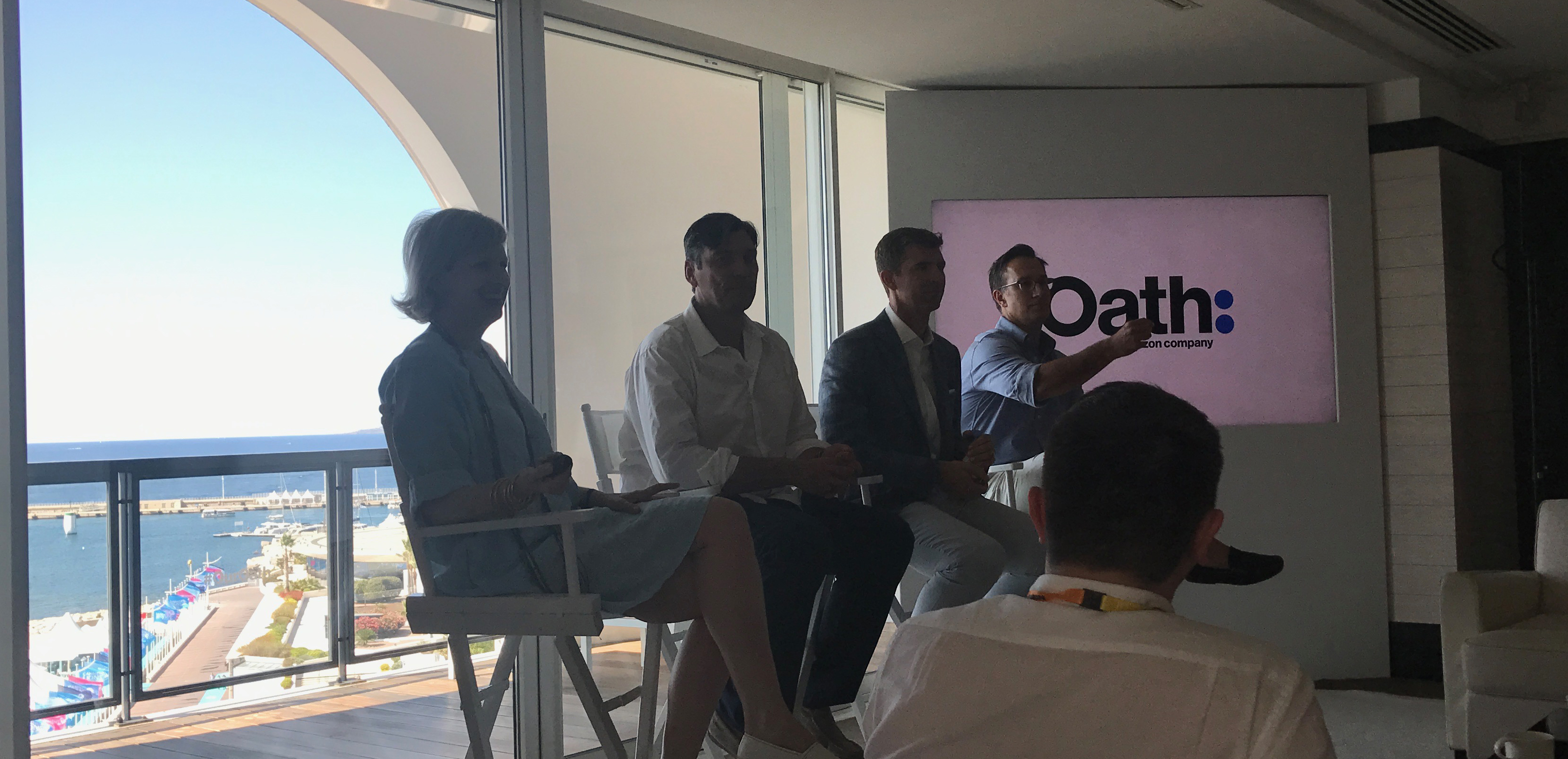
Oath is having its coming-out party in Cannes.
On Monday, AOL executives officially launched Oath at the advertising festival in Cannes, following the close of Verizon’s $4.8 billion acquisition of Yahoo last week.
The execs also clarified lingering questions about how it will integrate assets from AOL and Yahoo into Oath’s pending ad tech stack.
“We have one of the most exciting opportunities by taking what AOL and Yahoo have built to have a single ad stack,” said Tim Mahlman, president of ad platforms at Oath. “We have the full intention of taking the best assets of both of these advertising stacks.”
Within the next six to nine months, Oath will combine comparable assets from the legacy internet companies, like demand-side platforms BrightRoll and AOL ONE and mobile exchanges Flurry and Millennial Media, into a single stack with a new brand name, said Oath CMO Allie Kline.
When Verizon announced its intent to acquire Yahoo in July, immediate questions were raised about how the new entity would smoothly integrate their respective stacks.
But Mahlman argued that there are actually more synergies than conflicts between the two platforms.
“Yahoo built a stack that reached global audiences by leveraging first-party data,” he said. “AOL built a foundation [as] one of the premier performance-based optimization technologies. They were built to go after advertisers from different standpoints.”

While Yahoo is stronger on the product and tech side, AOL brings its own strengths related to “creative around content,” said Oath CEO Tim Armstrong.
But Verizon, for its part, is no stranger to content distribution via mobile and on over-the-top TV (OTT) devices, which should appeal to brands. Through its platforms, Verizon can “instantly render any piece of content on 300 different devices in the world instantaneously,” Armstrong said.
“We have one of the largest platforms that directs traffic,” Armstrong declared. “By improving the areas of our content properties and partnerships, we can be a very big disruptor in the content space.”
Oath is in the process of launching live content and group viewing experiences using Yahoo and AOL technologies.
Still, questions remain about which assets of each stack will be folded into the larger platform and which will become part of the technology underpinning Oath.
“We’ll be transparent about what’s staying and what’s going away [when the new stack launches],” Kline said.
Execs also shed light on how Oath will leverage Verizon’s data to reach mobile audiences.
Verizon plans to share hashed IDs from its subscriber base for targeting on any AOL or Yahoo property, as well as for  media bought through its platforms, Mahlman said.
Oath will combine that data with first-party data from Yahoo’s search and email channels to feed its new DSP. Data coming from partnerships with other unnamed first-party data providers will also flow into a data “lake” or repository.
“We’ve also rolled out real audiences that are authenticated, human and respectful,” Mahlman said.
Some advertisers are looking to Oath, with its 1.3 billion consumers and 1 trillion monthly ad requests, as a long-awaited contender to the Facebook/Google duopoly.
But Oath won’t be a walled garden like its competitors, Armstrong said. The company has inked a third-party measurement partnership with Moat and is working on standards with the Interactive Advertising Bureau.
“You hear the advertising community crying out for trusted relationships and places to do marketing,” he said. “We’re going to be able to deliver a very trusted, safe audience experience overall.”
As Oath grows and expands into new markets – the company hopes to hit $20 billion in revenue by 2020 – it will make a big push into TV, Armstrong said.
AOL already has a TV production studio in New York City and a show on Verizon FiOS. Oath will grow connections with streaming and over-the-top platforms through its Digital Media Services unit, which streams 300 million linear TV shows to mobile devices a month, Kline said.
On a broader scale, Oath hopes to build connections with consumers through its owned and operated brands and with marketers through two-way, mutual interactions.
“Google is search; Facebook is social,” Armstrong said. “We’re going to be brands. We want to invest in places people don’t understand as well.”
But despite speculation to the contrary, Armstrong claims that Oath doesn’t have Google and Facebook in the crosshairs.
“We’re not looking to go head-to-head with Google and Facebook,” he said. “We want to go head-to-head with the consumer.”
Brand marketing has long been a one-way information highway, Armstrong said, with brands broadcasting information to consumers without much chance for dialogue.
“There’s a very big whitespace for brands to have a more definitive two-way relationship with consumers,” he said.








