

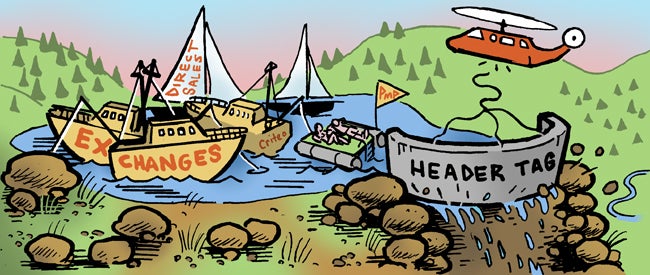
2016 was the year that header bidding crossed over and became a disruptive force in the ad industry.
The wave of publisher adoption spurred tech companies to create header bidding solutions. Vendors that were slow to adopt, like Rubicon Project, saw their stock crash as their rivals scooped up market share in a world where being at the top of the waterfall no longer mattered.
Power swung back to publishers who added header bidding. It boosted their revenue and increased transparency, helping them evaluate partner performance.
“Inventory prices went up rapidly as more adopted [header bidding],” noted Chip Schenck, VP of programmatic sales and strategy at Meredith. “It very quickly showed that 1) programmatic should not only be about lower price, and 2) the auction dynamic moved against buyers for the first time since RTB was introduced.”
Google responded to the rise of header bidding in April with its own product, which would allow greater competition within its ad server – and potentially quash the need for header bidding.
“The alpha project had to have been the shortest development cycle ever for them,” Schenck said. Meredith was among the initial publisher partners for the program. “That Google needed to take [header bidding] seriously was big news.”
Publishers didn’t wait for Google’s exchange bidding product to get off the ground, instead focusing on making improvements to existing header bidding setups. Many added open source or proprietary wrappers that allow them to more seamlessly manage partners.
“Many if not most larger publishers have made the transition into a wrapper this year and explored additional relationships,” said Tim Wolfe, USA Today’s VP of revenue operations. USA Today added a wrapper this year, which improved page load times.

Looking ahead to 2017, header bidding will continue to evolve, as publishers with multiple partners may start culling the herd.
“Header bidding gives the publisher more opportunity to openly and transparently evaluate the strength of a relationship,” Wolfe said. “We haven’t dropped anyone yet; we are in the process of creating the criteria by which we will potentially demote or flat-out remove partners from contention.”
Throughout the industry, header bidding standards will emerge. The IAB Tech Lab mulled guidelines around header bidding wrappers this year, though it has yet to make a decision. “It’s more about what we didn’t do this year. We are being thoughtful about standards,” said Alanna Gombert, GM of the IAB Tech Lab.
And header bidding will start to move server-side. Google’s exchange bidding solution employs server-to-server connections, and other ad tech players – including Amazon and Media.net – are coming up with their own products that move header bidding server-side as well.
But publishers are skeptical of any one wrapper or server-side solution attempting to gain advantage in the header. After all, the priority that Google gave its Ad Exchange Service kicked off the whole header bidding trend.
“Google spent $3.1 billion buying DoubleClick to get position. Microsoft spent $6 billion on Atlas and didn’t even get a position,” said Andrew Casale, CEO at Index Exchange. “In 18 months, we priced the value of a position at zero. [Header bidding] created a seismic shift on how ad tech operated.”
The Year In Header Bidding
January: AppNexus works on header bidding for mobile apps.
February: Publishers use header bidding wrappers to fold in more partners and manage latency.
February: OpenX sees server-side header bidding as a long-term solution.
April: Google responds with exchange bidding in dynamic allocation. The early-stage product will allow other demand partners to compete with Google DoubleClick Ad Exchange.
May: AppNexus publicly refuses to participate in Google’s solution.
July: CBC trials video header bidding from Index Exchange.
August: Rubicon Project posts a dismal earnings call, citing a slow reaction to header bidding. Stock drops over 30%. Could other SSPs follow?
August: Buyers mull how header bidding affects them and plot strategies to adapt to changing supply.
August: Facebook develops a header bidder.
September: Google adds more demand partners and publishers to exchange bidding.
September: Data-management platform Krux enters the header bidding arena.
November: Criteo talks about moving to a first-price auction in order to regain priority in publishers’ header bidding wrappers.
November: AOL adds a header bidding wrapper.
December: Amazon develops a server-side header bidding solution.
December: Purch moves all its header bidding partners server-side.
December: Media.net makes a market push for its server-to-server header bidding product.








