

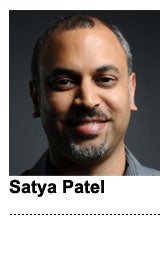
 Satya Patel has a long history in the advertising technology world on both the product and venture capital sides, including roles at Google/DoubleClick and Battery Ventures. Most recently, Patel worked at Twitter as its VP of Product until June of this year. Today, he’s looking ahead to a startup of his own, offering only a tiny tidbit to AdExchanger: “I’m beginning to assemble a team to pursue a startup idea addressing pain points that I have experienced as both a consumer and business person.”
Patel recently shared his views with AdExchanger on a variety subjects related to the ad tech industry and current trends.
AdExchanger: Given your experience at Battery, Google and Twitter, you clearly have interest as a venture investor and a product leader. Can the two mix? Do you have a preference?
SATYA PATEL: Yes, I have an interest from multiple perspectives. My view is that you should find as many different ways of applying your knowledge as possible, as long as you have the time to do all of them well. The knowledge and insights you gain from operating in a particular market can’t be obtained as easily standing on the sidelines. My personal preferences and interests lead me to build products and companies while also attempting to leverage that experience to make intelligent investments.

Do you agree that the digital ad future is “native”? If so, where does the Doubleclick Digital Marketing platform fit in? Isn’t social or “nativeness” outside of the DoubleClick platform which is more “traditionally” addressed by Facebook and Twitter, for example?
Maybe not surprisingly, I think that there is room for both “native” and “traditional models” for the foreseeable future. While display advertising will continue to work (to the extent it does) for the traditional desktop web, new social and mobile platforms will require native models to avoid “interrupting” the user experience. Twitter Promoted Tweets is a great example of a native model that is introduced seamlessly into the user experience and can actually add value to the overall experience because it is organic content that gets targeted to users based on their explicit and implicit interests at a particular moment in time.
Looking at the ad tech landscape, do you see too many companies? What happens to them in the next 18-24 months?
Given the size of the advertising market, I’m not sure there are too many companies, but there are definitely too many companies doing the same thing. Consolidation and companies struggling to raise additional financing will be the major trends in the next 18-24 months.
For entrepreneurs seeking investment today, what common mistakes are they making in your estimation?
The most common mistakes that I’m seeing are 1) optimizing for valuation and 2) assuming that if you build it they will come. For many companies, seeking and getting the highest valuation actually limits options for the company down the road, both in relation to future financings and potential exits. Too many entrepreneurs are focused on building a beautiful, functional product but not enough on user acquisition, retention and overall go-to-market strategy. Those need as much attention as the product for a business to scale effectively.
Do you consider yourself a proponent of agile product development? Or agile startup development?
I’m a proponent of the philosophy that there is no magic formula or silver bullet approach to creating company success. I think that the complexities introduced by the need to develop for both web and mobile platforms and audiences require different approaches to each. Product-market fit still needs to be the ultimate objective for a startup. Ideally that comes quickly and cheaply, but that is far from reality for most startups.
Finally, what surprises you about digital ads today?
Nothing truly surprises me as old habits and models are hard to break and there really isn’t an incentive for innovation on the buy side. That said, it’s odd to me that there isn’t more pressure for digital ads to move more quickly away from models optimized for pageviews rather than engagement. I’m also amazed that most mobile ad companies seem to be doing nothing more than taking the innovations that worked in the display world and porting them to mobile. I’m more interested in companies that are focused on where the puck is going rather than where it’s been (to paraphrase The Great One).
Follow Satya Patel (@satyap) and AdExchanger.com (@adexchanger) on Twitter.
Read more from our Venture Capital investor series…
- Genacast’s Gil Beyda
- Norwest Venture Partners’ Jeff Crowe
- Valhalla Partners’ Kiran Hebbar
- Foundry Group’s Seth Levine
- Redpoint Ventures’ Chris Moore
- Lightspeed Venture Partners’ Bipul Sinha
- Satya Patel
- Union Square Ventures’ Andy Weissman
- First Round Capital’s Chris Fralic







