

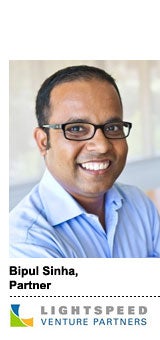
 Bipul Sinha saw the early days of the latest ad tech era when he helped lead investment in ad verification firm DoubleVerify on behalf of Blumberg Capital in 2008. In 2010, Sinha moved to Lightspeed Venture Partners (LSVP) where ads remain a focus and companies such as news aggregator Pulse, social ad platform MyLikes, and personalized TV company Peel have become his investments of choice.
In an interview with AdExchanger, Sinha framed today’s Lightspeed investment themes by pointing to mobile engagement, online marketplaces and what he calls a “new enterprise stack.” He added that “the socialization of the consumer and enterprise applications are huge opportunities and that the human connected Internet is still in the early stages of its evolution.” Given Sinha’s pre-VC, enterprise vendor experience, it would seem he should know…

AdExchanger: You worked at Oracle and IBM in past “lives.” Both are getting increasingly active in the marketing and advertising spaces. What’s the end game for these companies in ads/marketing?
BIPUL SINHA: The marketing and advertising spaces are largely enterprise, business-to-business plays, and Oracle, IBM, Microsoft are wisely staking their positions in these large and growing markets. The social Internet is changing how products get launched and marketed. We are essentially living in an era of collapsing marketing chain where companies can use the social media and other online tools to reach and measure their audience. The end game for Oracle and IBM is probably to offer a marketing/sales application suite to identify, target, run campaigns, and measure results. I believe that Salesforce.com, LinkedIn, Google, Oracle, IBM and Microsoft would eventually compete vigorously in this market and the market could sustain a few winners given the size of the opportunity.
Many say that mobile has finally “arrived” – whatever that means. What’s missing in the mobile opportunity today?
In terms of mobile ad tech, I believe that the ad format is still the missing ingredient. The banner ad is not very amenable to the mobile phone screen real estate. A better ad format that can scale with respect to inventory, audience reach and user engagement would certainly help advertisers to drive more ad dollars into this media. The mobile app discovery is another area where app stores need to step up their game.
What’s your view on the ad tech landscape? Is it over-invested? And, is LSVP still interested in investing?
We are always looking for investment opportunities in large, impactful markets which include ad tech. There are areas within ad tech that are more saturated than others but overall it is a large and growing space. We believe that the mobile ad tech space would create a few scale companies and we continue to look for those.
LSVP is an investor in Pulse. Why is Pulse good for publishers? And, doesn’t an aggregation service such as Pulse reduce ad impressions for a publisher, for example?
Pulse is great for publishers. Pulse has created a large platform for bite-size consumption of news and information on your mobile devices. The Pulse platform provides publishers with a new channel to reach and grow their audience across all the mobile devices. Publishers view Pulse as accretive to their audience reach and scale strategy and that’s why they have been joining the platform in large numbers.
So does Facebook advertising work? And was the IPO a mistake?
Facebook advertising does work. Unlike Google , Facebook advertising is discovery and awareness oriented and, given the company’s user scale and engagement, I believe that Facebook would be able to monetize very well. An IPO event is just a milestone in the journey of a large, successful company. I believe that Facebook would continue to build great products, enthrall its user base and generate large revenue in the process notwithstanding the IPO perception.
As you look at entrepreneurs across the table from you today, how are they changing?
The core of every entrepreneur is the same – drive, edge and uncommon market intuition. However, they are getting younger and more informed about the venture process. I believe that the democratization of entrepreneurship along with an ever reducing time to scale (I call it an age of acceleration) would create more large scale technology companies in the next 10 years than what we had in the last 10 years.
Follow Bipul Sinha (@bipulsinha), Lightspeed Venture Partners (@lightspeedvp) and AdExchanger (@adexchanger) on Twitter
Read more from our Venture Capital investor series…
- Genacast’s Gil Beyda
- Norwest Venture Partners’ Jeff Crowe
- Valhalla Partners’ Kiran Hebbar
- Foundry Group’s Seth Levine
- Redpoint Ventures’ Chris Moore
- Lightspeed Venture Partners’ Bipul Sinha
- Satya Patel
- Union Square Ventures’ Andy Weissman
- First Round Capital’s Chris Fralic








